Why International Buyers Source Hardwood Charcoal from Nigeria
Dense tropical hardwoods, established production regions, direct port access and competitive pricing make Nigeria one of the world's most important origins for natural lump charcoal.
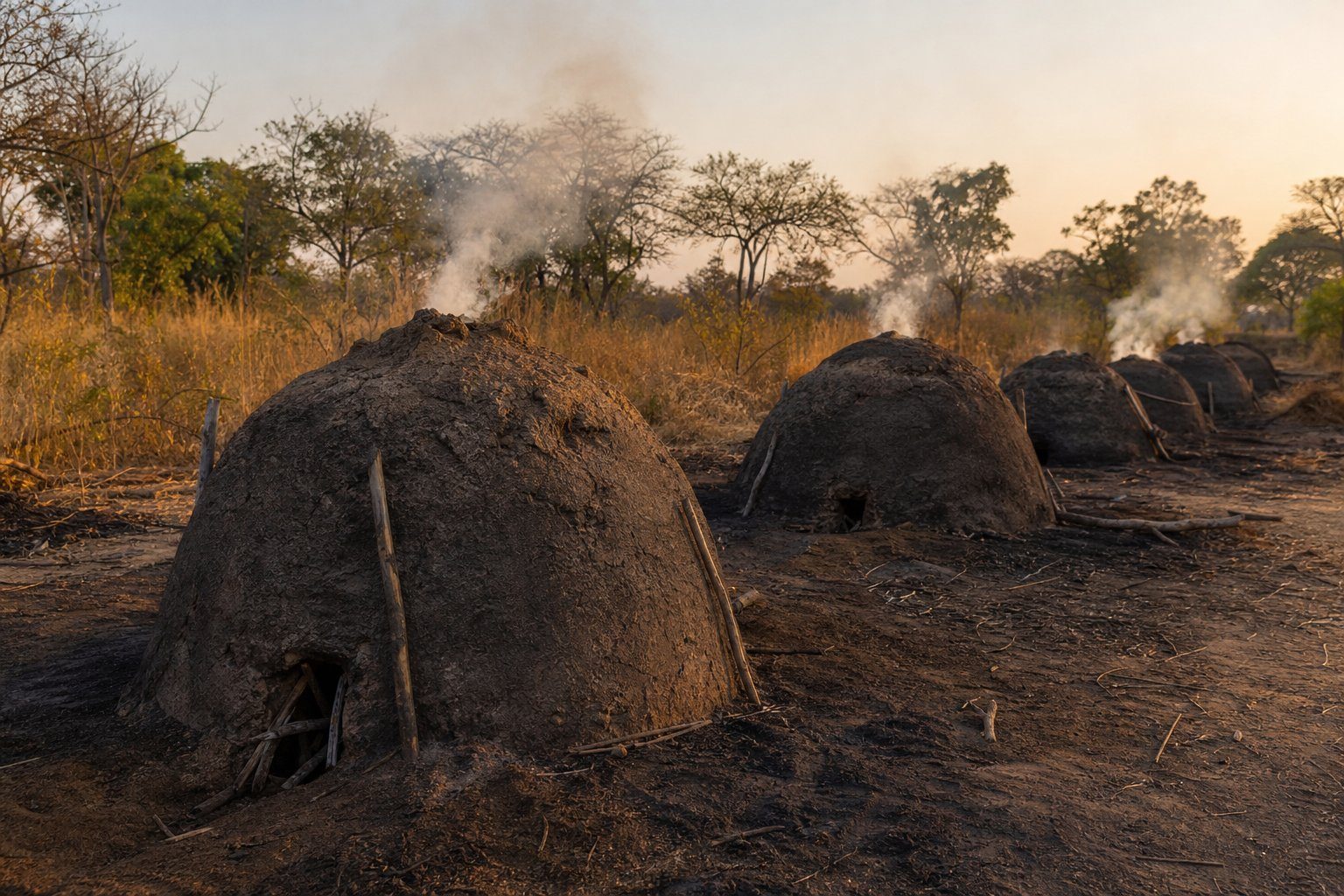
Walk through a barbecue aisle in Istanbul, a restaurant supply depot in Dubai or a wholesale yard in Athens, and there is a reasonable chance the lump charcoal on the pallet started life in the savanna woodlands of Nigeria. Nigeria is consistently counted among the world's largest producers of wood charcoal, and a substantial share of its export-grade production is directed at the Middle East, Europe and Asia. This article explains why.
1. The raw material: dense tropical hardwoods
Charcoal quality starts with wood density. The hardwoods harvested across Nigeria's Guinea and Sudan savanna belt — species traditionally used by local producers for their burning qualities — are dense and slow-growing, which translates into charcoal that is heavy for its size, burns long and produces comparatively little ash. For restaurant and barbecue applications this is exactly what end users pay for: a lump that holds heat through a service rather than collapsing into dust.
2. An established, scalable production base
Charcoal production in states such as Oyo, Kwara, Niger, Nasarawa, Kogi and Ogun is a long-standing rural industry. That depth matters to importers because it means volume can be assembled reliably. A single container requires many tonnes of consistently sized lump; an exporter who works with a network of producing communities and operates its own sorting yards can fill repeat container programmes rather than one-off shipments.
3. Direct access to deep-water ports
Nigeria's main export gateways — Apapa and Tin Can Island in Lagos, with Lekki Deep Sea Port adding capacity — are served by the major container lines on routes to the Mediterranean, the Gulf and Asia. Sailing times to Turkey, Greece and the GCC are short enough to keep landed costs competitive, and frequent sailings reduce the risk of a shipment missing a seasonal sales window.
4. Competitive landed cost
Production economics, scale and port access combine to make Nigerian lump charcoal competitively priced against alternatives from South America, Eastern Europe or South-East Asia — particularly when the comparison is made on a like-for-like basis of dense natural hardwood lump rather than briquettes or soft-wood charcoal.
5. Flexibility in grading and packaging
Because sorting is still largely done by hand at the yard, Nigerian exporters can tailor size profiles and packaging more flexibly than highly automated origins. Buyers can specify restaurant-grade large lumps, uniform medium BBQ lumps or mixed sizes for local re-grading, and have them packed in plain PP sacks, printed retail bags or jumbo bags as required.
The buyers who succeed with Nigerian charcoal are those who partner with an exporter that controls sorting, moisture, packaging and documentation — not just a trader who buys bags at the roadside.
What buyers should check
- Grading discipline: ask how lumps are screened and what fines allowance applies.
- Moisture management: charcoal that is bagged too soon after production is heavier (you pay for water) and is a self-heating risk at sea.
- Documentation competence: certificates of origin, phytosanitary/fumigation certificates, analysis reports and carrier-required self-heating documents must be in order.
- Visibility: expect loading photographs, a loading report and clear communication from booking to bill of lading.
At Renamy Charcoal Nigeria we built our export process around exactly these checkpoints. If you are evaluating Nigeria as an origin, request a quotation or talk to our export team.
Sourcing charcoal from Nigeria?
Get a written quotation and specification within two business days.
More Insights
Ready to Source Export-Grade Charcoal from Nigeria?
Tell us your grade, quantity, packaging and destination port. Our export team will prepare a detailed FOB or CIF quotation and a sample plan.